Most requirements end in a lab report.
Knowing the rule is not evidence. These are the methods authorities and customers ask for, the standards behind them, and what each one actually proves.
- Live obligation
- Art. 5(5) PFAS
- Typical lead time
- 2 – 4 weeks
- Methods listed
- 6
- Standards cited
- 5
- Last reviewed
- 2026-08-16
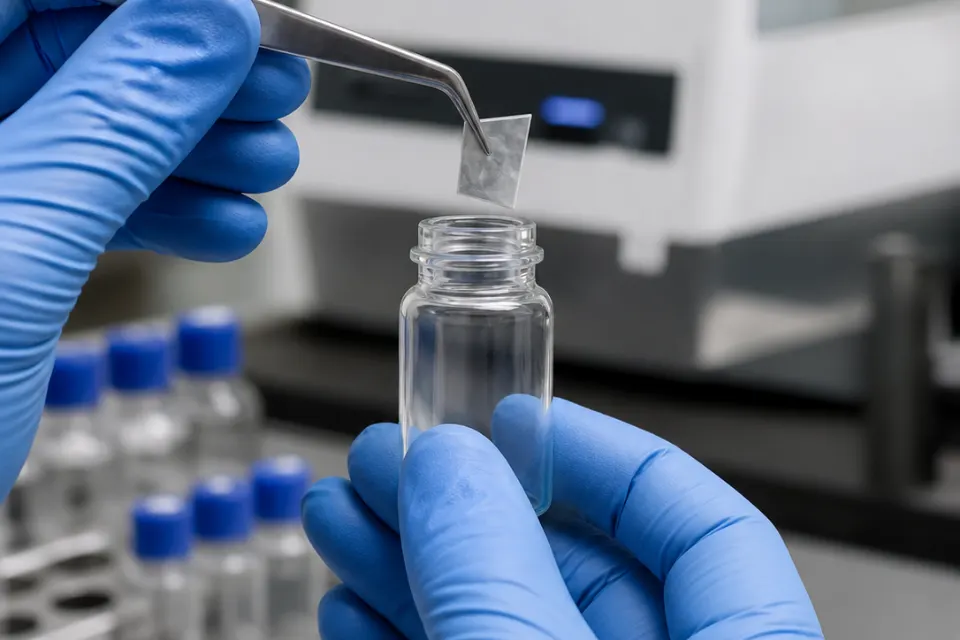
A market surveillance request does not accept a supplier’s word.
Most of PPWR resolves, eventually, into a document you either have or do not have. For substances of concern and recycled content that document is a test report; for recyclability it is an assessment; for minimisation and empty space it is a calculation you can reproduce.
This page maps each obligation to the evidence that satisfies it, so you can commission the right test once rather than the wrong test twice.
PFAS limits on food-contact packaging have applied since 12 August 2026. If you place grease-resistant paper or board in food contact on the EU market and hold no fluorine data, that is a live exposure, not a 2030 problem.
What to test, and what it proves.
Each method is listed against the article it satisfies. Lead times are indicative and depend on sample preparation, not on the instrument.
Which test does each requirement need?
Not every requirement ends in a lab. Three of the eight are satisfied by calculation and documentation alone — which is cheaper, and just as auditable.
| Requirement | Evidence type | Method | Live today |
|---|---|---|---|
| Art. 5 — PFAS & metals | Lab report | Total fluorine + targeted LC-MS/MS; ICP for metals | ● yes |
| Art. 6 — Recyclability | Assessment | Design-for-recycling scoring, sortability trial | ◐ provisional |
| Art. 7 — Recycled content | Audit + analysis | Chain of custody per EN 15343 | ◐ method act pending |
| Art. 10 — Minimisation | Written justification | Annex IV criteria, dimensional data | ● yes |
| Art. 24 — Empty space | Calculation | Volume ratio per pack configuration | — from 2030 |
| Art. 12 — Labelling | Artwork conformity | Composition data + digital carrier check | — from 2028 |
Not sure which test you need?
Run the specification through the checker first. It tells you which obligations apply, and only then which of them actually require a lab.